

Last week I had the privilege of presenting at the third edition of the Foreseeing Government Audit Future Conference in Dubai, hosted by the Financial Audit Authority of the Government of Dubai under the theme of Smart Audit. The room was full of professionals who were not debating whether AI belongs in the audit function. They were working out how to do it defensibly. This post is the substance of what I shared, written for those who were not in the room. The presentation, and this post, take a perspective shaped by that audience: public-sector auditors with a mandate to protect public funds. The core messages do not change across industries. Where AI fits in the lifecycle, what must be governed before it is used, and where the auditor’s judgment stays are the same questions in a bank, a hospital or a ministry.
The premise: the tower, not the logs
I have said for years that when risk moves like live air traffic, reviewing yesterday’s flight logs is no longer enough. Traditional audit is a control tower reviewing completed flights: it investigates past incidents and provides periodic oversight. AI-enabled audit is the radar screen. It monitors every aircraft in real time, detects trajectory deviations, predicts collision risk, and coordinates intervention before impact.
That is the whole shift. Everything that follows is about how an audit function gets from the logs to the radar without losing the thing that makes it an audit function: professional judgment, documented and defensible.
AI does not replace the lifecycle. It changes what each phase can see.
The lifecycle below is a generic one. Your function may name the phases differently or merge two of them, and that does not matter; it is here to illustrate where AI can be leveraged, not to prescribe a process. I built the presentation on that structure deliberately: auditors do not need a new process. They need to know where, inside the process they already trust, AI changes the work. One practical use case for each phase:
| Phase | Use case and what AI does | Short example | What changes for the auditor |
|---|---|---|---|
| Audit universe | Dynamic risk intelligence modeling. Analyzes historical audit results, operational metrics, regulatory updates and enterprise risk indicators to reprioritize auditable entities continuously. | Procurement spend is re-scored monthly across departments; two cost centers with rising vendor concentration move to the top of the plan mid-year. | Focus is continuously risk-driven rather than tied to a static annual plan. |
| Planning | Intelligent risk assessment and audit planning. Evaluates prior findings, incident data and control environments to recommend scope and objectives; drafts process maps and risk-control matrices. | The model reads three years of findings and the procurement policy and produces a draft risk-control matrix the team edits rather than builds from a blank page. | Planning becomes more precise and forward-looking. |
| Fieldwork | Automated transaction testing and anomaly detection. Evaluates full transaction populations for unusual transactions, control failures, behavioral anomalies and fraud indicators. | All 50,000 vendor payments are scored. Seventeen duplicate payments across six vendors surface where a 3–5% sample had found two. | Coverage expands beyond sampling; detection confidence rises. |
| Reporting | AI-assisted documentation and workpaper review. Summarizes evidence, drafts narratives and executive summaries, flags inconsistencies against prior findings. | Draft finding narratives are generated from the workpapers; the auditor rewrites the judgment and keeps the structure, and the report goes out a week earlier. | Less time on documentation mechanics, more on interpretation and insight. |
| Follow-up | Automated remediation effectiveness validation. Tracks corrective actions across systems, verifies post-remediation control performance, flags recurring or ineffective fixes. | A corrective action on vendor bank-detail changes is overdue; the model flags it, and the same control weakness recurring in a second entity, before the next cycle. | Repeat findings surface earlier; accountability strengthens. |
| Monitoring | Continuous auditing and real-time assurance. Scores live transaction, access and operational feeds against baselines; raises deviations as they occur. | A segregation-of-duties bypass is flagged 72 hours after it begins, while management can still act, instead of at the next quarterly fieldwork. | The auditor moves from periodic reviewer to proactive risk advisor. |
Six phases, one practical use case each. Examples are drawn from an illustrative public-procurement scenario, not a client’s results.
The fieldwork row is the one I spend the most time on in the room, because it is where the argument stops being theoretical. Sampling gives us statistical confidence. Population analysis gives us risk transparency. And the thread that runs through all six rows is the same: the model ranks and evidences. It does not conclude. The auditor tests the pattern, decides what is reportable, and signs the finding. That accountability never transfers to the machine. What changes is our ability to see, and the confidence with which we can say we examined everything, not a slice.
What must be in place first
Before an audit function uses AI on an engagement, six things must exist. This is not a theoretical governance discussion. For a government audit function, every tool used in an engagement must be defensible, not just to the audit committee but to the entities audited, to leadership, and to the public whose interests the function represents. AI outputs can influence findings, shape conclusions and support regulatory action, so the governance around them must be as rigorous as the governance around any other audit methodology.
| Pillar | Rule of thumb | What it means in practice |
|---|---|---|
| Policy and authorization | Know the rules before you use a tool. | A documented AI use policy before any auditor opens an AI tool on an engagement: approved tools, permitted uses, and prohibited uses. Ad hoc use with no policy is an independence and quality risk waiting to surface. |
| Data governance and integrity | Garbage in, garbage out. Validate before you trust. | A model is only as reliable as the extract. Incomplete or upstream-manipulated data produces output that looks authoritative and is built on sand. Validate the data before trusting the result. |
| Model validation and explainability | If you can’t explain the flag, you can’t file the finding. | When a model flags a transaction, the auditor must be able to say why, in audit terms, not technical ones. What pattern, what deviation from expected behavior. Explainability is a professional requirement. |
| Human accountability | The machine has no designation. You do. | The machine is not subject to the IIA Code of Ethics. The auditor is. Every AI-assisted conclusion has a named human who interpreted it, validated it, and will stand behind it. |
| Documentation standards | If it isn’t in the workpapers, it didn’t happen. | When the tool was used, on what data, how outputs were validated, who reviewed. This protects the engagement and protects the auditor when findings are challenged. |
| Independence and objectivity | AI can reduce human bias. Judgment decides what it means. | Vendor relationships, data contamination and model bias can compromise conclusions. Treat AI tool selection with the scrutiny you would apply to any engagement resource. |
AI expands what auditors can see. Governance determines whether what they see can be trusted.
Top tips and tricks
I close every presentation with my top tips and tricks. They are sequenced the way an audit function actually builds AI capability rather than announces it: memory first, then evidence from your own engagements, then an outside reference point, then governance of your own use.
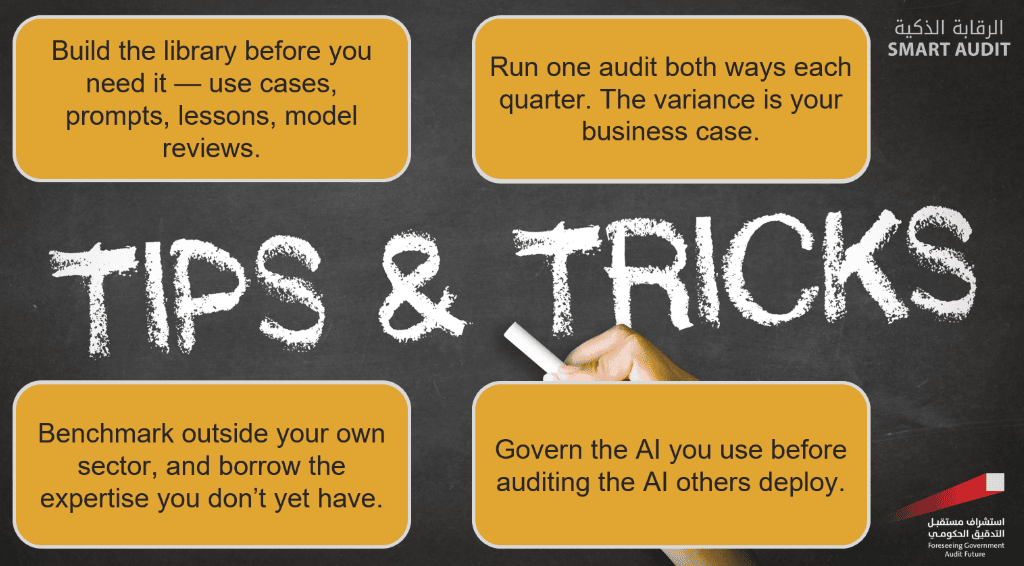
Build the library before you need it.
Your first AI-assisted engagement will teach you more than it finds. The question is whether anyone else can use what it taught you. Use cases, prompts, tool evaluations, control mappings, model reviews and lessons learned, including the failures, from the first engagement, not the fifth. The test: can the second engagement start where the first one finished?
Run one audit both ways each quarter.
You will be asked to justify this investment, and you should not answer with a vendor’s claims. Run the AI-assisted and traditional approaches in parallel over the same population and document the variance honestly, noise included. Evidence from your own file is the only argument that travels.
Benchmark outside your own sector, and borrow the expertise you don’t yet have.
Public-sector audit benchmarking against public-sector audit is too narrow a reference set on AI. Financial services is ahead on transaction monitoring and model validation; healthcare has done the hard thinking on explainability. A data scientist or an AI governance specialist can be engaged rather than hired. What you cannot outsource is knowing which competencies you are missing.
Govern the AI you use before auditing the AI others deploy.
Government audit bodies will increasingly be asked to provide assurance over AI-enabled systems in procurement, service delivery and financial control. An audit function that cannot explain its own model has no standing to challenge anyone else’s. Govern your own AI first, and do it visibly.
What I took home
A good presentation is a tuning fork, not a bell. You strike it and listen for what resonates. What resonated in Dubai was not the coverage numbers. It was the question of how an auditor defends what the model found: the explainability pillar drew more questions than any use case. That tells me where the next version of this material, and of my AI audit course, needs to go deeper. The auditors in that room are not piloting this. They are operationalizing it, under a national mandate, and they asked the questions of people who have to sign their names to the result. I came to share what I know. I left with a sharper version of it, and with real appreciation for a community that takes this work as seriously as it deserves.
My thanks to the Financial Audit Authority and the UAE Internal Auditors Association for the invitation and for an event of real quality, to my fellow speakers, and to the auditors in the room. I will be back.