
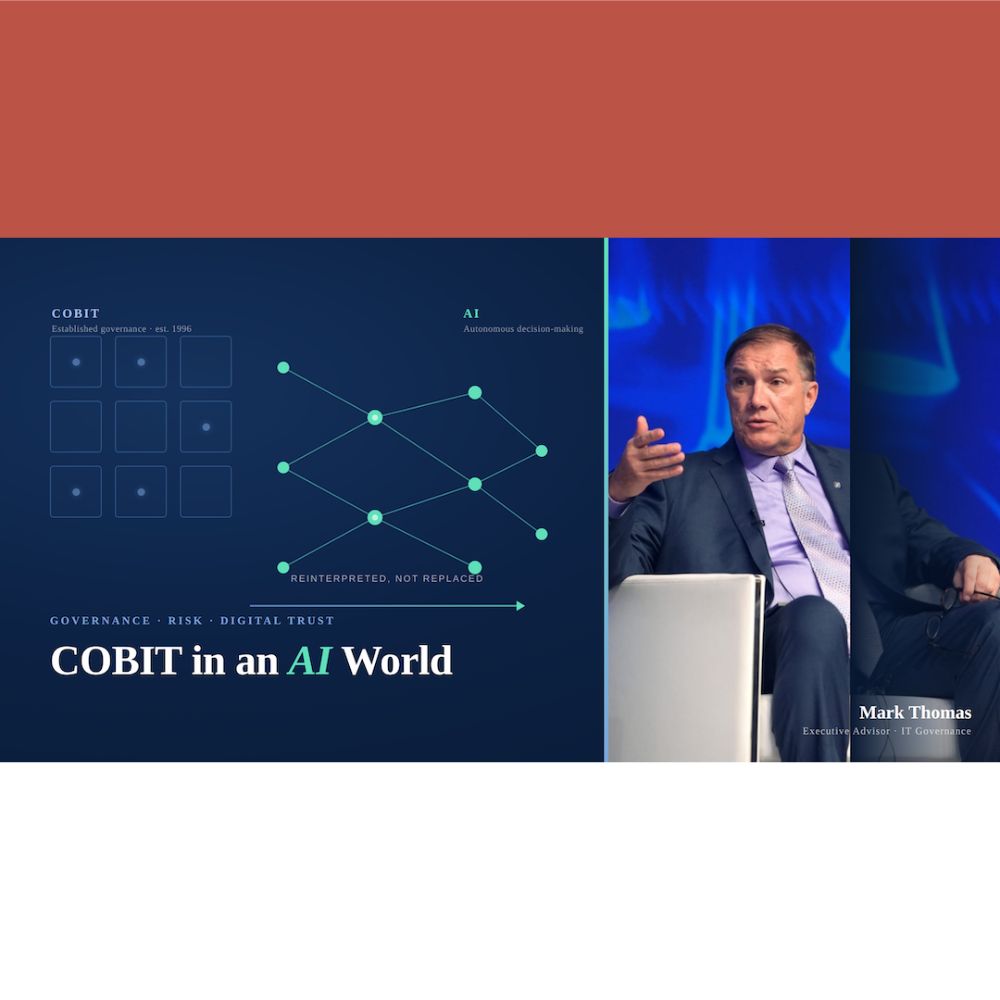
My answer surprises people: no, we don’t throw them out. We reinterpret them.
Here’s the contrarian view I keep returning to: COBIT isn’t outdated in the AI era. It’s underutilized. Organizations racing to bolt on new “AI governance frameworks” are often skipping a more important step: verifying whether the governance infrastructure they already have can carry the weight of what’s coming. That distinction matters. It’s the difference between load-bearing and decorative.
And worth pausing on for a moment, COBIT is turning 30 this year. First released by ISACA in 1996, the framework has outlasted entire generations of technology trends, fads, and “next big thing” announcements. That longevity and structured decision accountability isn’t an accident; it’s the result of a framework grounded in something more durable than the technology of the moment. For those who want to revisit the history or explore the current guidance, ISACA’s COBIT hub is the place to start: https://www.isaca.org/resources/cobit.
Governance frameworks were never about the technology; they were about the decisions. COBIT, at its core, has always been a structured way to answer four questions: Who decides? On what basis? With what oversight? And how do we know it worked? Those questions don’t change when the decision-maker is an algorithm instead of a manager. What changes is HOW we answer them… and that’s where most governance professionals are getting tripped up.
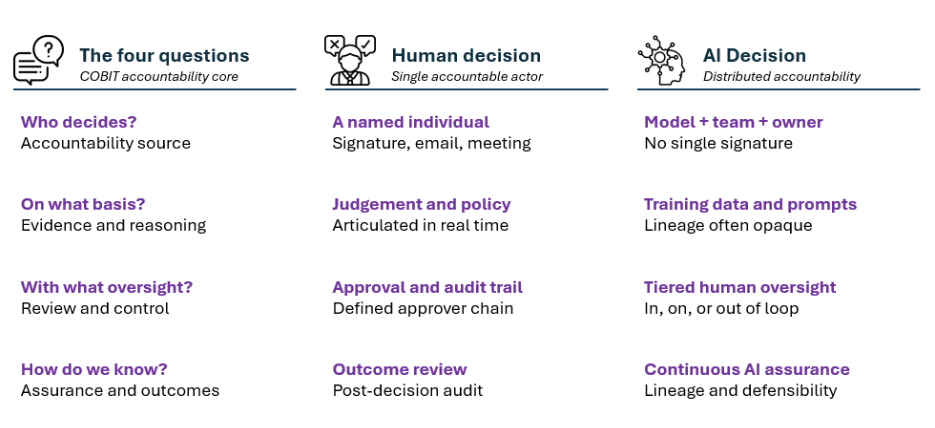
I propose three reinterpretations every IT governance professional should be thinking through right now.
First, treat AI assurance as a first-class control objective, not a side project. Traditional IT assurance asked: did the system do what we told it to do? AI assurance must ask something harder: did the system do what we intended, in conditions we anticipated, with outputs we can defend? That’s a different kind of audit and one many internal audit functions aren’t yet equipped to perform. ISACA’s emerging guidance on AI auditing, combined with NIST’s AI Risk Management Framework, gives you scaffolding. But scaffolding only works if it’s anchored to something solid…which brings me back to COBIT.
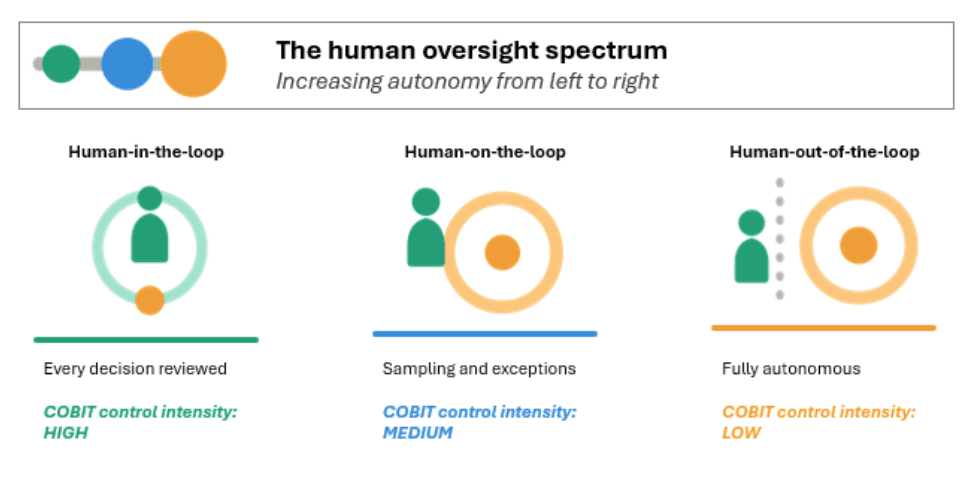
Second, redefine “human oversight” before someone defines it for you. Regulators in the EU, UK, and increasingly the US are writing the definition as we speak. If your governance program waits, you’ll inherit a definition that may not match your operating reality. Oversight isn’t binary, it’s a spectrum from human-in-the-loop (every decision reviewed) to human-on-the-loop (sampling and exception review) to human-out-of-the-loop (fully autonomous within defined boundaries). Each tier requires different COBIT-aligned controls. Each carries different risks. And each needs to be a deliberate choice — not a default that emerged because no one asked.

A colleague framed the stakes better than I could. I’ve collaborated with a trusted colleague on this subject for years, and in a recent conversation she put it this way:
Final Thoughts
The IT governance professionals who will come through this well are doing the harder, less glamorous work of stress-testing what they already have. Here’s where I’d start:
- Audit your existing governance framework against AI use cases already in production. Not pilots. Production.
- Define your human oversight tiers explicitly, in writing, approved by your governance committee. Don’t let regulators or incidents define them for you.
- Map every material AI decision point to an accountable role, not a team. Diffuse accountability is no accountability.
- Expand your risk taxonomy to include AI-specific risks. This includes drift, bias, hallucination, adversarial inputs, third-party model dependencies, and integrate them into your enterprise risk register.
- Treat AI assurance as a recurring reporting item. If it’s not on the agenda, it’s not being governed.
COBIT in an AI world isn’t a relic. It’s a foundation. IF you’re willing to reinterpret it with the rigor the moment demands. Thirty years in, that foundation is still the one to build on.