
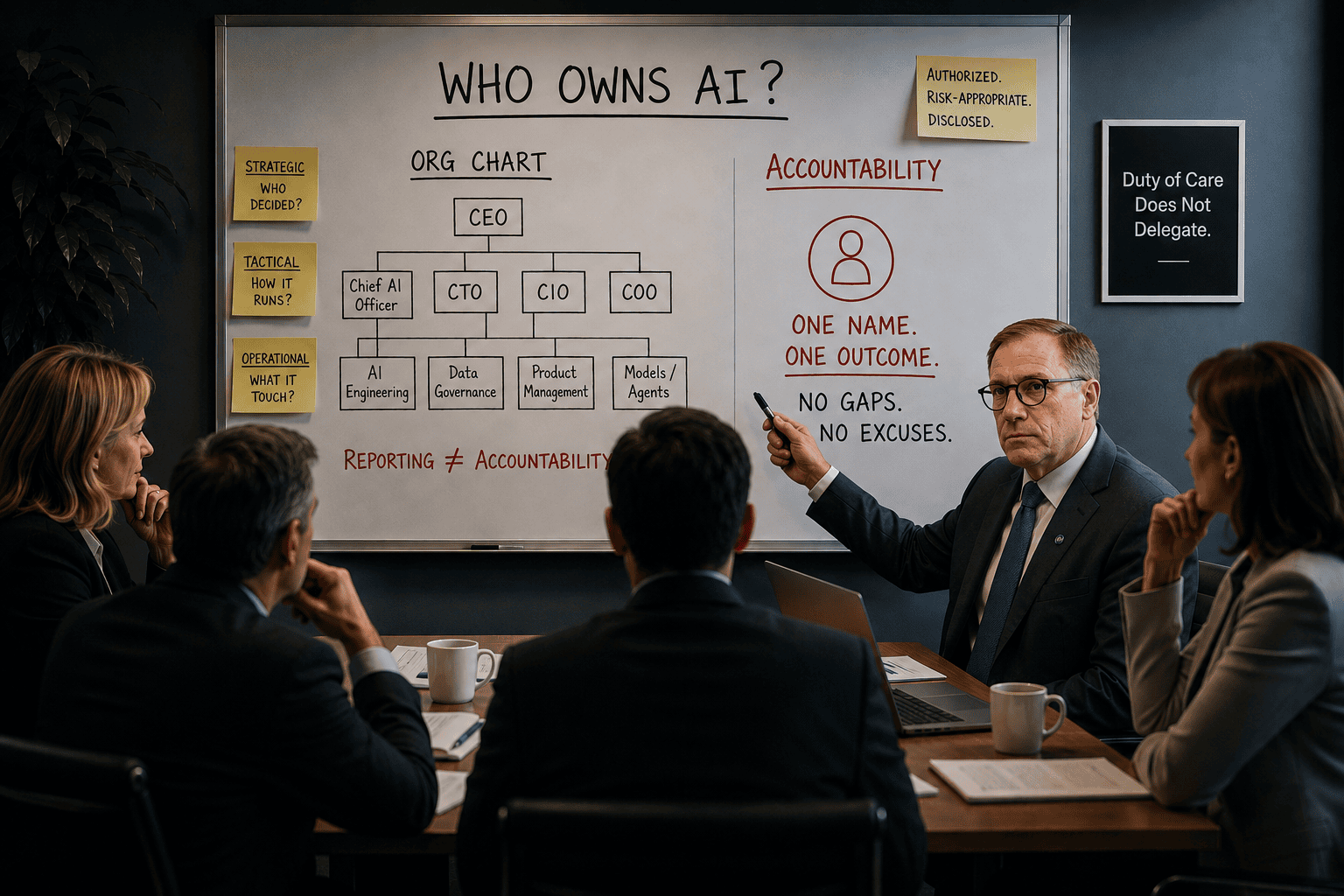
AI ownership is distributed. Accountability isn’t. And most organizations are confusing the two.
A client sent me an “AI org chart” last week. It was good. CEO at the top. Chief AI Officer, CTO, CIO, and COO below. AI engineering, data governance, product management, models, agents, the works. Someone had clearly thought hard about it. And it still couldn’t answer the question they had asked me: Who owns AI here?
An org chart tells me who reports to whom. It does not tell me who is accountable when AI does something nobody authorized. Those are different questions, and the gap between them is where AI governance quietly fails. A reporting line tells you where a person sits and who signs their performance review. Accountability tells you whose name goes on the outcome when a system does something nobody authorized. You can draw a perfect chart and still have nobody standing in that second position.
I see this constantly. Ask a leadership team who owns AI and you will get four confident answers, all different, all sincere. The CIO says integration. The CTO says architecture. The Chief AI Officer says vision and adoption. The COO says workflow and productivity. Every one of them is describing something real that they own. None of them describes accountability for the outcome, and that is precisely the problem.
The chart my client sent me had a missing box at the top. No board of directors, no technology committee, no audit or risk committee, no governing council of the kind you would find in a public sector or nonprofit equivalent. The chart began at the CEO and worked down, which means it described management. Not governance. That omission is not a design oversight. It reflects how most organizations think about AI right now: as an operational capability to be built and staffed, rather than as a set of decisions requiring authorization from the people carrying fiduciary duty. I made a related argument in Strategy Without Governance Is Just Expensive Hope. A plan nobody is accountable for is not a strategy. It is an aspiration with a budget line. An org chart nobody is accountable to is the same thing, drawn sideways.
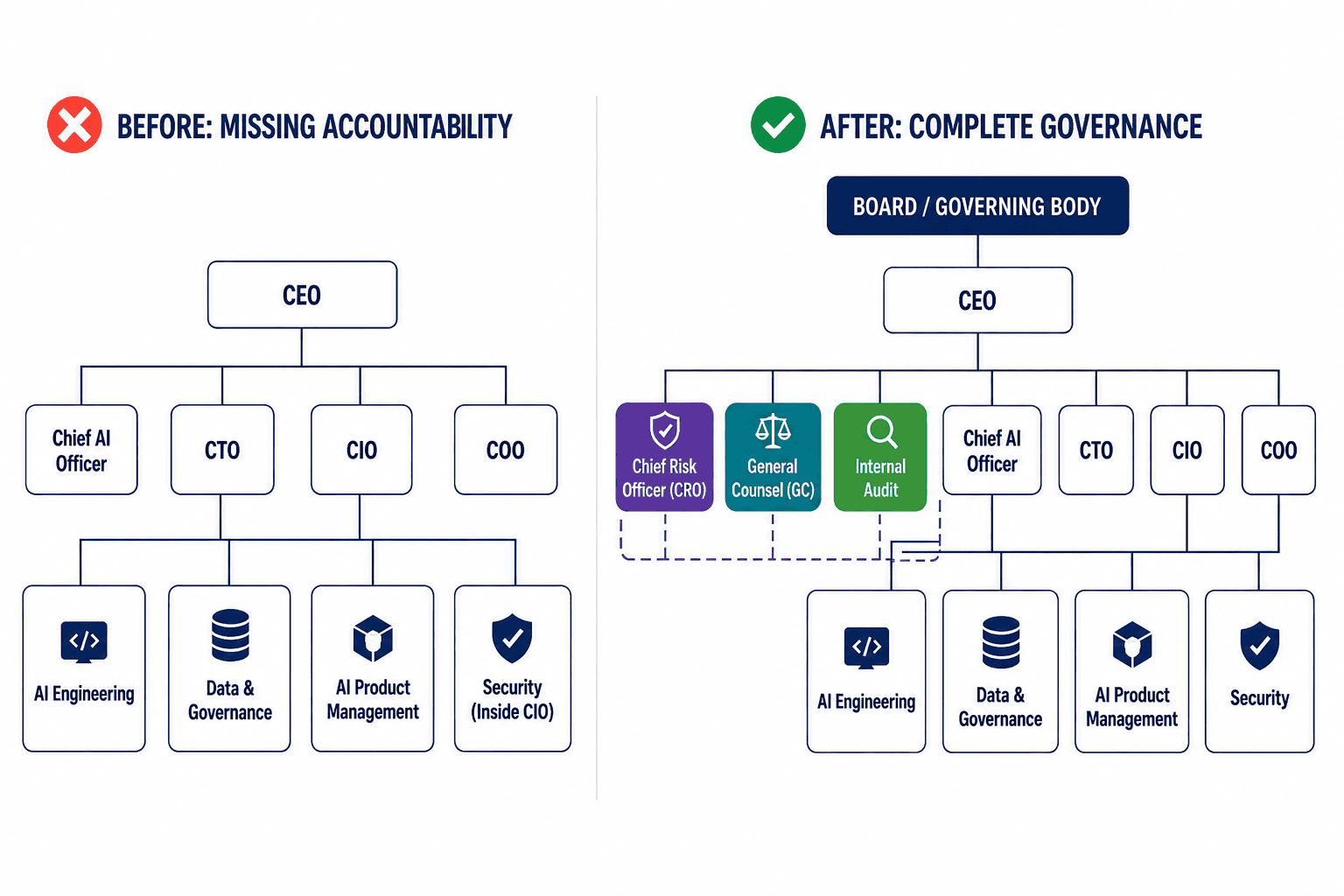
Boards do not own AI. Let me be direct about that, because I have watched directors visibly tense at the suggestion they now need to understand model architectures. They do not. What the board owns is accountability for whether AI use in the organization is AUTHORIZED, risk-appropriate, and disclosed. Duty of care does not delegate. You can delegate the work. You cannot delegate the answer to “did you know, and did you approve?”
Ownership fragments. Accountability does not. COBIT has been clear on this for three decades and the distinction has never mattered more than it does now. I walked through that thirty-year track record in detail when COBIT hit its anniversary this year, and the RACI distinction is the part that has aged best. Responsibility can be shared across many people. Accountability is singular. When a RACI has four names with an A, you do not have four accountable executives. You have zero. Everyone is responsible for something. Nobody is accountable for the whole.
A friend of mine put it more bluntly than I would have. Ed McCabe and I have been circling this problem from different directions for years, and he described what he keeps finding:
|
“Everyone knows which developer built the agent, but folks seem to get selective amnesia when asked who actually authorized it. It just “started working on something” on a Monday morning, accessing sensitive data with privileges that would make Domain Admin jealous. And don’t get me started if anyone ever asked if AI was actually necessary.” |
Building is documented. Approving is assumed. That asymmetry is most of the problem right there, and it is why the question keeps coming back to me from clients who already have a chart. Ed’s last point is the one that lands hardest in a board room: somewhere between the idea and the deployment, nobody was asked whether AI was necessary at all. That question has an owner too. The org chart does not name that person either.
When people ask who owns AI, they are asking three questions at once. This is the part that trips up otherwise sharp executive teams, because they keep answering at the wrong altitude.
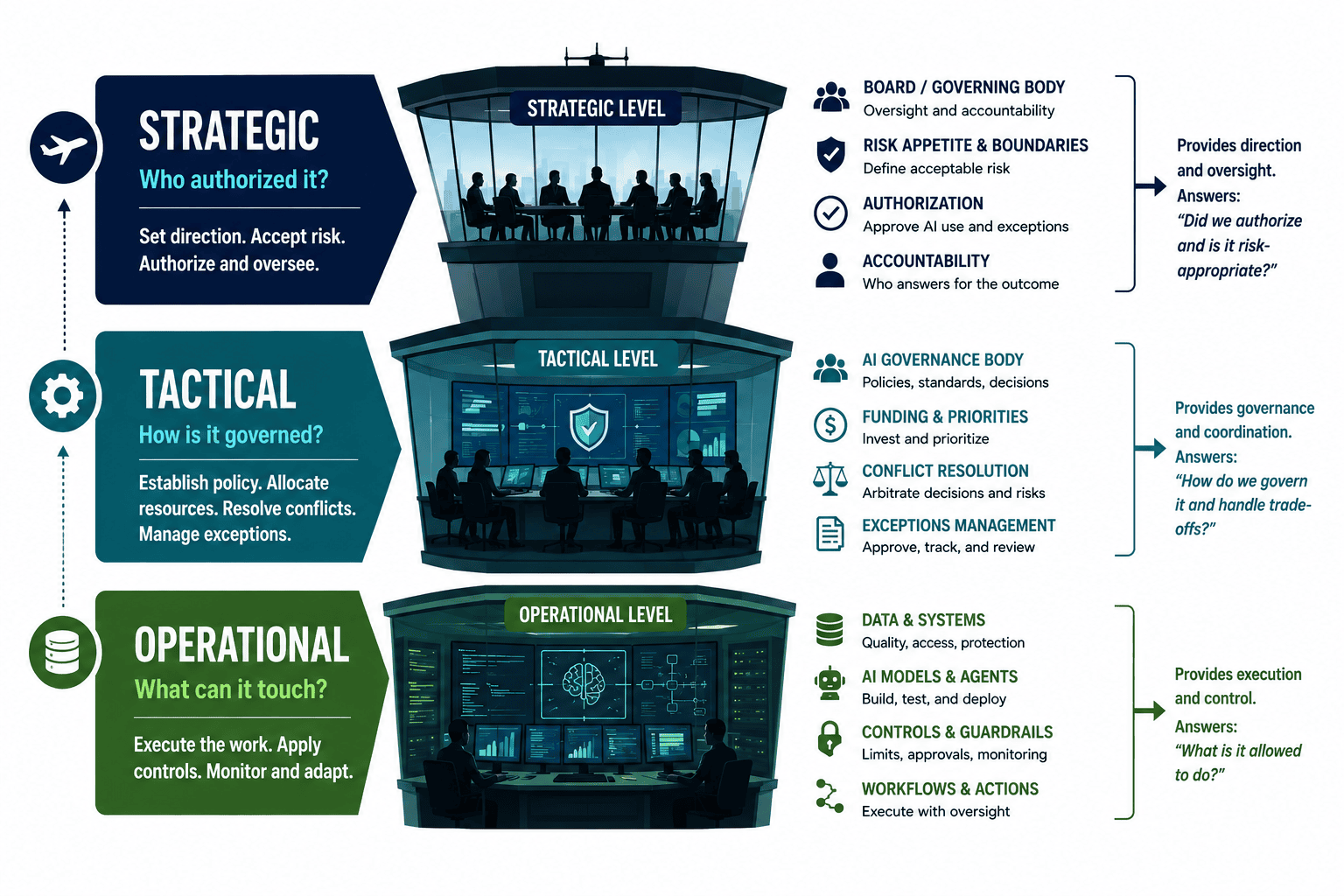
At the STRATEGIC altitude, the question is who decided. Who authorized this system to exist, who set the risk appetite it operates within, who approved the exception when one was granted. That is board and CEO territory. It is not a Head of AI question, no matter how capable that person is.
At the TACTICAL altitude, the question is how it runs. Who sets policy, who funds it, who arbitrates when the CISO and the AI product manager want opposite things on the same Tuesday. This is where an AI governance body earns its existence, and it is the box most organizations skip. When clients ask me who owns AI, they are usually describing the pain of not having this layer.
At the OPERATIONAL altitude, the question is what it can touch. Which data, which systems, which actions, which approvals. Data quality, access, privacy, guardrails, production workflows. Real ownership, real work, and the altitude where every chart I see is fully populated.
The chart my client sent me was excellent at the operational altitude, adequate at the tactical, and silent at the strategic. Which is a fair description of AI governance across most large enterprises right now.
A few roles were missing from the middle, too. No Chief Risk Officer. No General Counsel. No internal audit. Security appeared only as a phrase inside the CIO’s box. That matters more than it looks. Under ISO 42001, the EU AI Act, and the NIST AI RMF, the obligations landing on organizations are legal and risk obligations, not engineering ones. If the people who own regulatory exposure are not on the chart, the chart is describing how AI gets built. It is not describing how AI gets governed. This mapping is where I spend the most time when I teach the AAIR curriculum for ISACA, and it is reliably the point at which the room goes quiet.
Here is the diagnostic I now use with clients. Forget the chart for a moment. Answer one question. An agent takes an action at 2am that nobody authorized. It touches customer data, or commits the organization to something, or produces an output a regulator later asks about. Name the ONE person who is accountable.
If the room goes quiet, or if you get several names, you do not have an AI ownership problem. You have an authorization problem, and no org chart will fix it. Structure cannot assign accountability that was never established in the first place. Readers of AI Agents Don’t Fail. Governance Does will recognize the pattern. The agent in that scenario is not malfunctioning. It is doing precisely what it was permitted to do, and permission is a governance artifact, not a technical one.
The good news: this is solvable, and it is solvable fast. It requires a decision, not a reorganization.
Final Thoughts
1. Put the board box on the chart, and label it correctly. The board does not own AI. It owns accountability for whether AI use is authorized, risk-appropriate, and disclosed. Draw it that way so nobody mistakes oversight for operation. Try this: add your governing body to the AI org chart this week and write its accountability in one sentence, not a bullet list.
2. Find the blank A column in your RACI. Walk your AI initiatives and identify, for each one, the single accountable executive. Not the responsible team. The accountable person. Try this: pick your three highest-exposure AI systems and name one accountable executive for each. If you cannot, that is your finding.
3. Answer at the right altitude. When someone asks who owns AI, establish first whether they mean who decided, how it runs, or what it can touch. Three questions, three different altitudes, and answering the wrong one is why the conversation keeps repeating. Try this: the next time the question comes up, ask which altitude they mean before anyone answers it.
4. Get risk and legal onto the chart. ISO 42001, the EU AI Act, and the NIST AI RMF create obligations that land on the CRO and the General Counsel, not on the engineering team. Try this: review your AI governance structure and confirm that whoever owns regulatory exposure has a seat and a vote, not a briefing.
5. Run the 2am test. Ask it out loud, in the room, with the executive team present. Do not send it in advance. Try this: pose the scenario at your next leadership meeting and note how long the silence lasts. That interval is your governance gap.
The problem was never that the AI org chart was wrong. It was answering the wrong question. AI ownership will always be distributed across technology, operations, data, risk, legal, security, and the business. Accountability cannot be. So stop asking only, “Who owns AI?” Ask the question your org chart cannot answer: “Who is accountable when it acts?”